The Turtle's Shell
The Turtle’s Shell — A Legend of the Village of Oćevije
Foreword
In the Vareš highlands, tucked between green hills and old beech woods, lies the half-forgotten village of Oćevije. Few know of it beyond those whose roots run deep into its black, damp soil. But those who do know it, know also of the Turtle’s Shell — a tradition so strange that outsiders don’t believe it, and locals never explain it. They only say: “That’s just how it must be.”
I. Spring 1643
It was the year Ibro-aga Cehaić had extended his rule from Vareš all the way to the last Christian villages in the northeast. A man huge as an elm, with a beard black as tar and a voice that rolled down the valley like thunder, he had one habit that women in every village prayed to God would pass them by — his arrival on the night of a wedding.
The right of the first night. No law had ever written it down, no sultan had ever openly sanctioned it, but the aga took it the way he took his taxes — calmly, regularly, without much talk.
Oćevije numbered scarcely thirty souls. All Croats, all Catholic, all under the same sky and the same fear. Fra Lovro Jurišić, the priest, came from Vareš once a week; the rest God left to them.
That year, in late April, when the forests had just flared into their first green, Luka Bevanda told his father he meant to marry.
The girl’s name was Manda Topić. Seventeen years old, quiet as morning, with eyes the colour of autumn oak. Luka was twenty-three, with hands like shovels and a heart like a vessel that could not be filled — it spilled over the moment he looked at Manda.
Old Bevanda, Nikola, was not glad at the news. Not because he disliked the girl — she was good and hardworking. Not because Luka was too young — twenty-three was nearly middle age, in those days.
He was unhappy because he knew what would follow.
“The aga will hear of it,” was all he said, without raising his voice, and he turned back to the pot on the fire.
II. Old Jela and What She Knew
There lived in Oćevije at that time an old woman whose true name no one remembered any more. Everyone called her Jela of the Woods, for she was said to know every stone and every root in the forest around the village. They said she was ninety years old, though she herself never confirmed it nor denied it. She would only laugh when asked, and say: “I’m as old as this mountain.”
Jela heard of Luka’s wedding the way she heard of everything — through the air, through the leaves, through some secret weave of her own by which she watched over the village.
On the third morning after Luka’s announcement, she knocked at the Bevanda house. She walked in unbidden, sat without being offered a seat, and spoke without preamble:
“There is a thing that can hold the aga back.”
Nikola turned. Fra Lovro, who happened to be there over coffee, raised an eyebrow.
“Turtles,” said Jela.
Silence.
“Turtles?” Fra Lovro repeated.
“Turtles. The Turks fear them like the devil. Or not fear, exactly — but they take them for a bad omen. Especially dead ones. Especially broken ones.”
She then explained something she claimed to have learned from an old woman in Travnik, who had learned it from a woman in Foča, who in turn had learned it from an ancient dervish who had once been a soldier and so had seen what soldiers see — namely, that Ottoman soldiers and spahis held an old superstition about turtles. A turtle’s shell, broken at the entrance to a place, meant that the place was “sealed under a curse” — or so the folk belief ran, spreading through the ranks and the caravans. No one knew where it had come from — perhaps the East, perhaps Persia, perhaps it was nothing but a tale — but tales are sometimes stronger than walls.
“If we break turtles at every entrance to the village, and scatter them there,” said Jela, “the soldiers won’t come in. They won’t even dare tell the aga they tried.”
III. The Night Before the Wedding
Three days before the wedding, Oćevije stirred to life in the strangest way. The children went out and caught turtles along the streams and pastures — and there was no shortage of them in that country, crawling under every stump, warming themselves on every sun-struck stone. They brought them back in cloth sacks, a dozen, two dozen, nearly thirty in all.
Nikola Bevanda took up his mallet — heavy, wooden, the one he used ordinarily for splitting firewood — and in a yard outside the village he began doing what Jela had instructed.
A blow. A crack. Silence.
It had to be done by one of the older men, for Jela said it was not fitting work for women or children. It was neither law nor faith — it was some code of her own that no one questioned, because no one was quite sure where it came from.
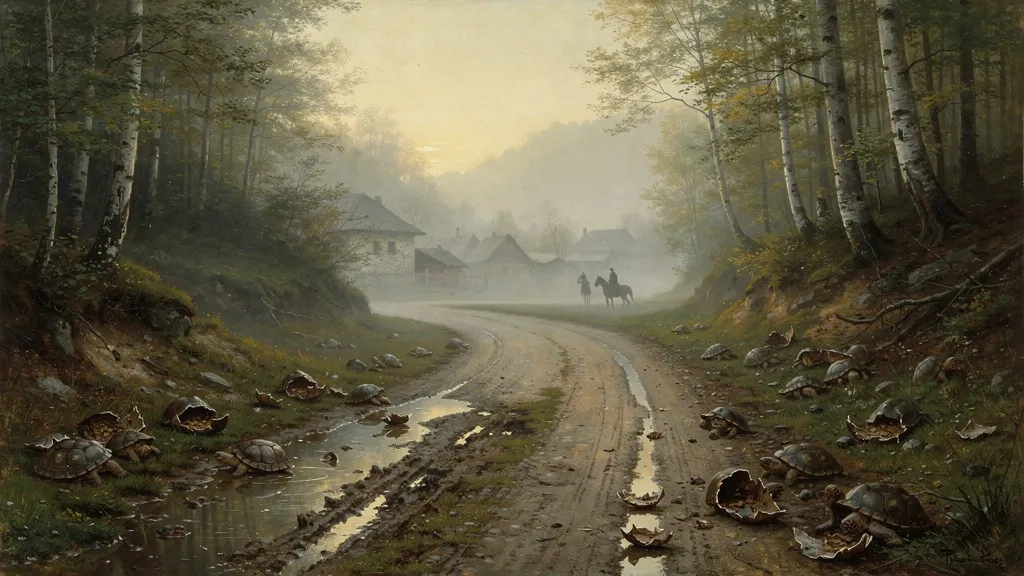
The broken turtles — shells, contents, all of it together — were scattered across all three approaches to Oćevije: on the road from Vareš, on the path along the river, and on the trail that came down from the mountain to the north. They scattered them far out, nearly a hundred metres before the first houses, so the soldiers would not even think of going further.
Old Đuro Barkić, Manda’s grandfather, stood watching the scene and said only: “God will forgive us the turtles. He gave us nothing else to work with.”
IV. The Wedding Day
The wedding was simple. Fra Lovro, a candle in the church niche, Luka and Manda arm in arm before walls that smelled of damp and incense. The women brought bread and honeyed wine; the children threw flowers.
As the wedding party set off for the Bevanda house for the feast, someone at the edge of the village cried out:
“Soldiers!”
Hearts stopped. Luka took Manda’s hand.
Far down the road, on a gentle rise, clouds of dust could be seen. Horsemen. Four, perhaps five soldiers, the aga’s banner on a lance.
And then they stopped.
From here, from the village, nothing could be heard — but Đuro Barkić, who had been sitting behind a plum tree by the road watching, later told how he saw the lead rider leap down from his horse, look at the ground, then quickly call another over. They looked, they talked, they waved their hands. One crossed himself, in his own Ottoman fashion. Another took something from his saddlebag and began moving his lips over it. A third simply turned his horse around.
Within five minutes, the cloud of dust was moving back toward Vareš.
In the village, someone began to weep. Then to laugh. Then both at once.
V. The Mallet Enters the Tradition
From that night on, the tradition remained.
It was no longer only about fear of the aga — Cehaić himself died just seven years later, of a fever, and the new aga was an older man given to rakija and quiet. But the tradition outlived its original purpose, as traditions always do.
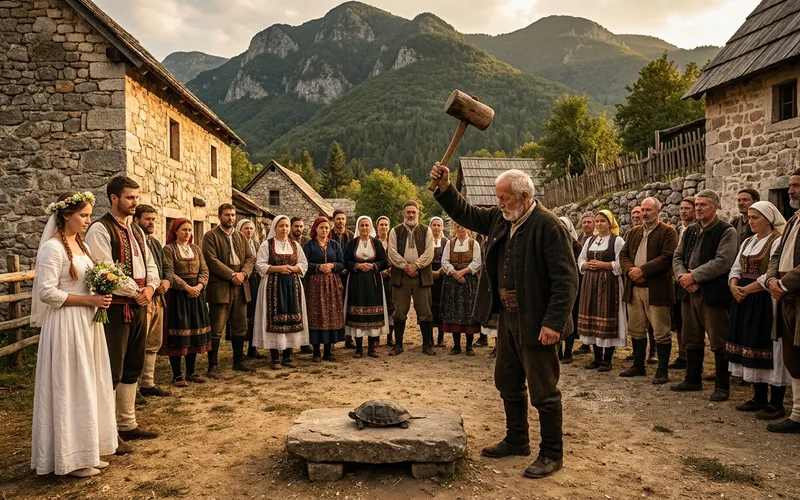
On every wedding day in Oćevije from then on, the groom’s father — or, if the father had died, the eldest male relative — would take up the mallet. A turtle would be brought from the forest, one only, and alive. It was set upon the parak, the flat stone slab before the house. The elder would speak a few words, always the same, always from memory, never written down:
“Little captain, brother, don’t hold it against us — you guard us living, and you guard us gone.”
A blow of the mallet. The shell would crack.
Then what remained was carried to the edge of the village and left there.
They said it brought the newlyweds luck. They said it drove off evil spirits. And they said, too, simply, that “that’s just how it must be” — and that explanation is perhaps the most honest of them all.
VI. What Remains
Oćevije today is a nearly empty village. Few houses have a permanent resident. But every year, when one of the descendants of an Oćevije family holds a wedding — be it in Vareš, in Sarajevo, in Germany or in Canada — someone among the elders says:
“We’ll need a turtle too.”
And someone always laughs. And always, whether they laugh or not, the tradition is carried out once more.
Mallet on stone. The shell cracks.
And the young couple pass through the threshold.