Anto's Clay
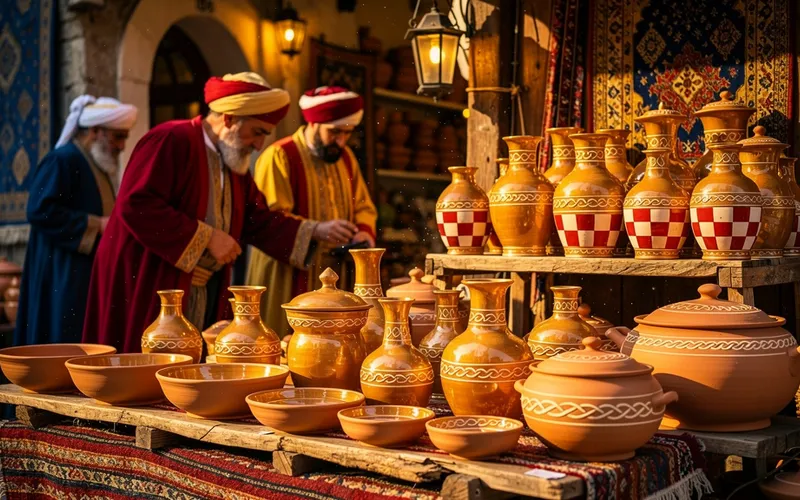
Anto’s Clay — A Legend of the Potters of Oćevije
Foreword
There are villages that live off the forest, villages that live off their livestock, villages that live off whatever they can sell to their neighbours at market. Oćevije lived off the earth — but not the earth they sowed, the earth they dug. Clay from Fox Hill, reddish and rich as butter, which in a skilled master’s hands became something no one in the Vareš region, nor far beyond it, could ever quite reproduce.
I. Fox Hill and Its Secret
Fox Hill got its name, so the stories go, because foxes once lived there in such numbers that at dusk the whole slope seemed to writhe. When exactly that had been, no one knew any longer. But the name remained, the way names do, even after the reason for them is gone.
The hill rose to the west of the village, steep and covered in hornbeam up to about halfway, and then suddenly bare — rock and earth, without grass, without trees. Children avoided it because the ground was slick and unpleasant, yellow-red, sticky after rain. For a long time the adults ignored it for the same reason.
Until one summer, sometime around 1580, Blaž Barkić — grandfather of the man who would become the legend — sat down on that slippery slope, took a handful of the yellow earth, and began kneading it out of boredom, waiting for his son to come down from the hill where he’d gone looking for a stray goat.
Blaž was a potter — but a poor one, as he himself admitted without shame. He made pots that leaked, jars that cracked in the fire, and platters that warped as they dried. The clay from the valley floor was disobedient and wilful in his hands.
But this clay, in his hands, was something else entirely.
It was smooth in a way that cannot be described in words, only in the palms of one’s hands. It did not stick to the fingers but slid off them like silk. It did not crack as you bent it, but followed the movement as if it understood what you wanted from it.
Blaž forgot the goat. He forgot his son too. He sat on Fox Hill until dark, kneading.
II. Three Generations to Perfection
Blaž began to dig. He had no tools, so he dug with his hands, later with an axe, later still with the help of neighbours whom he talked into it by various means — rakija, mostly. He hauled the clay out of the hill and carried it home in baskets, and then made pots that no longer leaked.
They were not beautiful. Blaž, after all, did not have an artist’s hands, only a craftsman’s. But they were sturdy, watertight, and light, unlike anything the potters of Vareš or Breza produced.
His son Ivan continued where his father left off. To sturdiness, Ivan added form — he began thinking about how a small pot sits in the palm, how a handle should be gripped, how a lid should fit. He travelled as far as Sutjeska and Fojnica, watched the masters there, and came home with ideas he then reworked in his own way.
Ivan’s son Anto was born in 1601, in a house that smelled of clay and woodsmoke, in a village that had already begun to understand what it meant to have something valuable underfoot.
Anto Barkić was the third generation, and in him the three generations flowed into one.
III. Anto’s Hands
It is hard to describe what kind of master Anto Barkić was without it sounding like exaggeration, because everything said about him sounds like exaggeration — and yet it was recorded, at least in the memories of enough people to become a living tradition.
They said Anto could judge the thickness of a vessel’s wall by touch alone, from the outside, without looking. They said he never deliberately made two identical pieces — every little pot, every bowl, every jug was, he claimed, a conversation with the clay, and the clay never says the same thing twice.
They said, too, that he worked at night, by a single torch, because he held that morning light made everything look worse than it was, and midday light made everything look better than it was — and he wanted to see the truth.
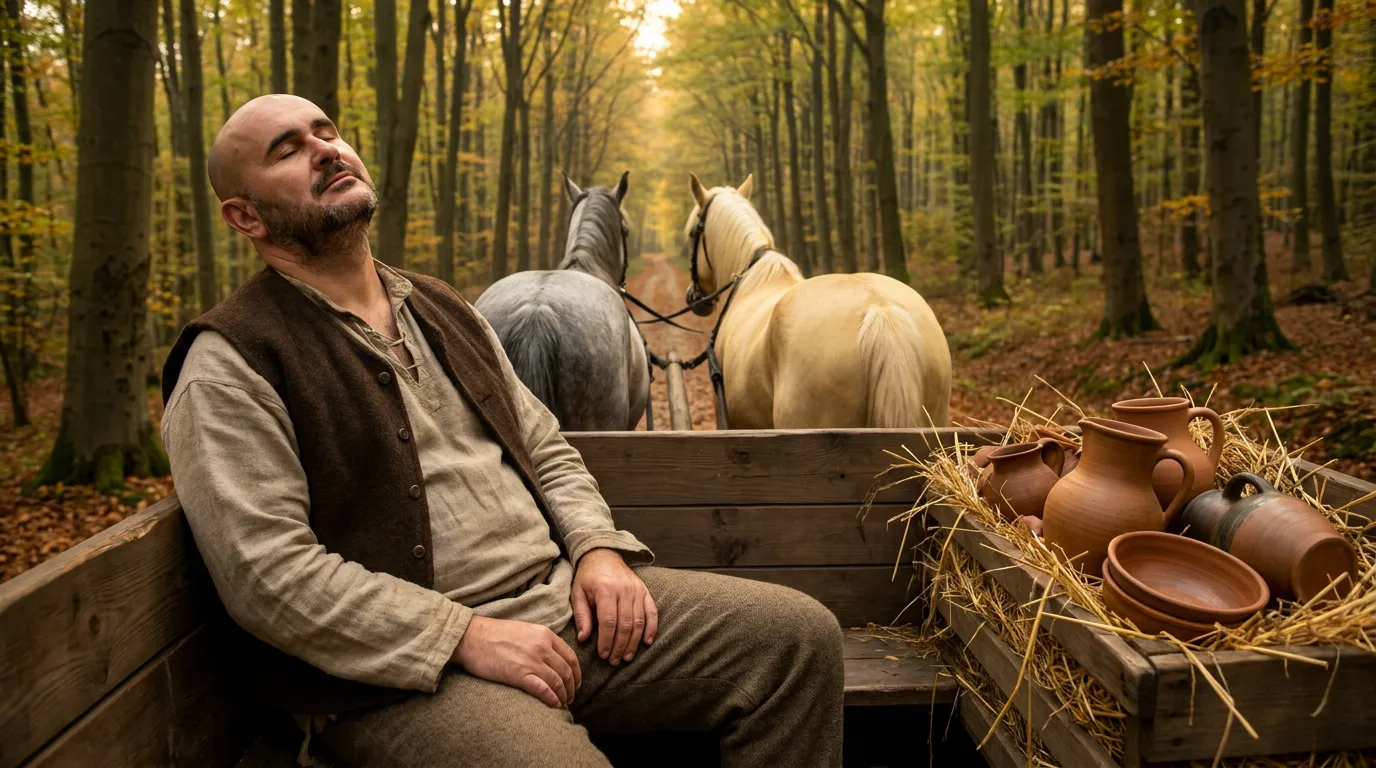
But for all that, Anto Barkić had one flaw — or virtue, depending on who was telling it. He loved to sleep. Not the way a man loves rest, but the way a man loves food, or music — with real passion, with devotion, without a trace of guilt. He said sleep gave him his hands — that in the morning, when he woke, his fingers knew what they were doing better than his head did.
This became especially well known at the fairs. When Anto loaded his cart with jugs and bowls and set off for Travnik, or Kiseljak, or Fojnica, almost without fail, somewhere between the village and the first hill, he would settle the reins, arrange himself on the seat, and fall asleep. Deeply, peacefully, hands folded in his lap. The jugs would clink softly against one another in the straw, and Sivi and Žuti — the horses he’d had for years, who had made that road so many times they knew it better than he did — would walk straight on toward their destination without a single wrong turn.
They said that once he was found in Travnik, in the middle of the main street, asleep in his cart while the horses stood quietly in front of the inn, waiting for someone to lead them to water. Handan, the innkeeper, reportedly wouldn’t wake him for half an hour, because it seemed too rude to do so.
“A man who sleeps like that,” Handan said, “either has no sins on his conscience, or has so many that it no longer matters.”
What is certain is this: Anto’s pots did not crack. They did not leak. They did not warp. Held to the fire, they turned almost translucent — the thin walls of Fox Hill clay, fired at just the right temperature, took on the colour of warm honey and let through enough light that you could count your fingers through them.
He added decoration too — nothing lavish or showy, just lines and dots that followed the shape of the vessel as though they had always been part of it, like veins on a leaf.
IV. How a Little Pot Reached Istanbul
It was no great adventure. It was neither a diplomatic gift nor a chance encounter. It was one middleman, at the right time.
Around 1638, a caravan of merchants passed through Vareš, carrying goods toward Sarajevo and, from there, further east. One of the merchants, an Armenian named Hagop, had a habit — in every place he stopped, he collected one object that caught his eye, some small trifle, a keepsake. Often it was pottery, since pottery travels light, doesn’t spoil, doesn’t rot.
At the inn in Vareš, someone showed him one of Anto’s jugs.
Hagop took it, turned it over, held it to the light, pressed his ear to its side, and gave it a light flick with his finger — potters, and anyone who understands pottery, know what that sound tells you. Badly fired clay thuds, dull and dead. Well-fired clay rings.
Anto’s jug rang like a church bell.
Hagop paid ten times the asking price, and asked whether he could order twenty more.
V. The Order That Changed the Village
Anto took the order with a distrust that quickly turned to curiosity. Twenty jugs. For whom? Going where?
Hagop didn’t explain everything, but he said enough: he had buyers in Sarajevo who had buyers further east still. Anto asked, “How far?”
Hagop laughed. “Far.”
Anto made the twenty jugs in almost three weeks — more carefully than ever, knowing they were going into hands unfamiliar with what he knew so well. He marked each one beneath its base with a small sign, a three-strand braid, which he used as his signature.
The caravan left, and Anto forgot about the jugs. He had work in the village, a wife and two children, and Fox Hill, which does not dig itself.
A year and a half later, Hagop returned.
He was not alone. With him was a man from Constantinople — a Turkish merchant, refined and calm, who spoke Arabic and Turkish, and a little Bosnian too, enough to be understood. He brought money with him, and a new order: a hundred pieces. Jugs, bowls, cooking vessels. He said that Anto’s jugs had seen Istanbul, that they had ended up at the Kapalı Çarşı — the Covered Market — and had sold faster than he’d expected.
Anto sat down on the bench outside his house and said nothing for a long while.
“A hundred pieces,” he repeated at last.
“A hundred,” the Turk confirmed.
“I’ll need help.”
VI. A Village of Potters
What followed did not happen overnight, but over the course of several years — though the direction was clear from the moment Anto began teaching his neighbours.
He was never stingy with his knowledge — everyone always granted him that. He kept no secrets about the firing, or the mixing of the clay. He showed anyone who wanted to watch, and in the village nearly every man wanted to watch, since pottery brought in money the land could not.
He founded what today would be called a workshop — back then it was just a longer house at the edge of the village, with a few carts and a large stone kiln. He worked alongside his son, Ivan the younger, three neighbours, and one young man from Vareš who had come to learn the trade and stayed for good.
Oćevije became a potters’ village. The caravans came. The name Barkić became, in certain circles, a guarantee of quality — if that triple braid was pressed beneath a pot, people knew what they were getting.
Anto lived to the age of seventy-two, which in those days was a patriarch’s old age. He worked to within his last decade — more slowly, but just as carefully. They said that toward the end he made only a single piece a week, but that each of those pieces was better than anything he had ever made.
He died in 1673. On the bench outside the workshop, they say — with clay still on his hands.
VII. What Remains of the Clay
Fox Hill still stands west of Oćevije today. Whoever climbs that bare, slippery slope and takes a handful of that reddish, rich earth in their palm will feel what Blaž Barkić felt that summer when he waited for his son and forgot the goat.
The clay is still there.
The master is not.
But in some houses around the Vareš region — and, so it’s said, in one collection in Sarajevo and one private drawing room in Istanbul, whose owner has no idea how it got there — there are vessels with a triple braid beneath the base. Thin walls the colour of honey. Flick them with a finger, and they ring.