Gorski Barkić and the Lord of the Mountain
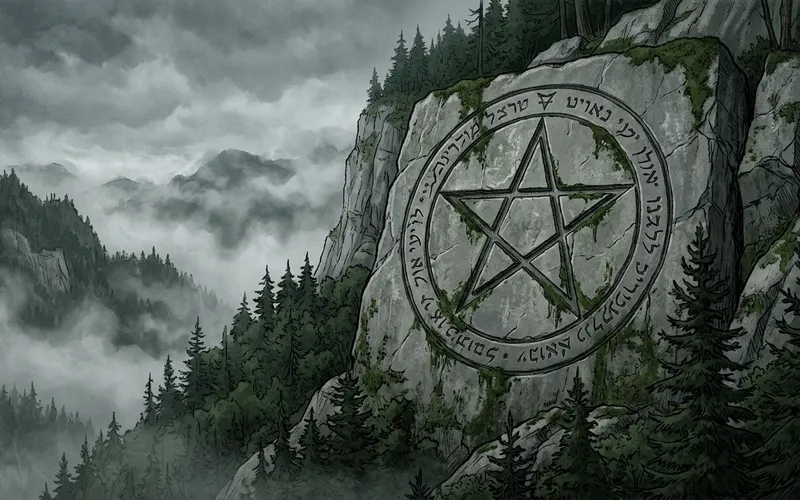
Gorski Barkić and the Lord of the Mountain
I. The Knights Who Returned
Not every man who sets out for the Holy Land stays there.
Some come back. And that, sometimes, is worse.
The year is 1208. Along Bosnian roads that were not really roads — only places where the mud was firmer than the mud around it — three men walk. They walk slowly, not because they are old, but because they are exhausted in a way that has nothing to do with legs. They are exhausted more deeply than that. Exhausted in regions where a man cannot rest by sleeping.
One is missing his left arm from the elbow down. Another has a face burned half away — not by fire, but by something he would not describe. The third, the eldest, carries a sword missing the cross from its hilt. He broke it off himself, with his own hands, somewhere in Palestine, and threw it into the sand. He said the cross on his sword had not helped him with anything he had seen, so he no longer carries one.
They are called — or were called — knights. They set out fifteen years earlier from Split, with the bishop’s blessing and the people’s songs. They return without blessing, without bishop, without people, and without the thing they’d carried with them when they left: faith that there was meaning in what they were doing.
They came upon Gorski Barkić in the village of Oćevija, looking for water.
II. Gorski
Gorski Barkić was twenty-four years old, the youngest son in a family that was not rich, but was not poor either — it was simply Bosnian, which meant plenty of mountain and little flatland, plenty of pride and little money, and quite enough questions the priest didn’t know how to answer.
Gorski had been the one who asked, since childhood.
Father Dominik, why does God allow Mavro to lose his child, if Mavro goes to church every Sunday?
Father Dominik, if the devil is so weak, why is God afraid of him at all?
Father Dominik, why does God kill more people in Scripture than Satan does?
Father Dominik once told Gorski’s father: “Your son has a problem with authority.” Gorski’s father answered: “He has a problem with the answers you give him.” They were not close after that.
Gorski was a carpenter by trade, but a carpenter who looked at wood longer than necessary. He would cut a beam and stop, and stare into the growth rings, and wonder what the wood remembered. The neighbours thought him strange. He did not contradict them.
When the three knights came to the well, he watched them for a long time. He did not see heroes. He saw men who had lost something that cannot be found again.
“Water?” he offered.
The one without an arm nodded.
III. What the Knights Brought
The one-armed knight was called Radovan, was from Dalmatia, and spoke slowly, with long pauses.
He told Gorski — not all at once, since they stayed three days, there being no reason to hurry — what he had seen. Of the Fourth Crusade, which had set out to liberate Jerusalem and ended by burning Constantinople. Of churches the knights had looted. Of relics they had sold. Of people they had killed in the name of God, who had prayed to the same God under a different name.
“That’s where I understood,” said Radovan, staring into the fire, “that the God they sold us doesn’t watch from above. And if he does watch, he approves. Either way is equally terrible.”
The one with the burned face, called Miroslav, drew something wrapped in leather from his bag that evening. It was a book — a manuscript in Aramaic and Latin, with illustrations the Church did not illustrate. Pressed between its pages were drawings: circles with stars inscribed inside them, formulas of invocation, descriptions of rituals so old that the ink they were written in was a different colour from the rest of the text — darker, almost black, as though someone had written with something thick.
“Where did you get this?” Gorski asked.
“In Damascus,” said Miroslav. “From a man who said he’d kept it for someone who would know what to do with it.”
“What’s in it?”
Miroslav closed the wrapping.
“Another time.”
IV. The Book
Gorski spent a week reading.
The book was partly philosophy, and partly something philosophy is not — it was practical. It contained descriptions of invocations its authors had called by different names across different ages: Baal, Astaroth, Baphomet, and finally, in Latin commentary someone had added in the margin, simply: Dominus Noster Inversus — Our Reversed Lord.
It was not a naive book. It promised no easy wealth, no revenge on an enemy. It promised knowledge — but described that knowledge as something that hurts on the way in, the way it hurts to look straight into the sun. It read: “He who calls does not receive an answer in words. He receives it as a feeling that does not know where it comes from, and that will not stop.”
The illustrations were precise. On one page was a five-pointed sign — a pentagram, a star inscribed in a circle, with Latin labels at each point: Ignis, Aqua, Terra, Aer, and at the lowest point, turned downward: Spiritus Contrarius. The reversed spirit. Gorski looked at that drawing for a long time.
Father Dominik had once told him, catching him drawing in the mud, that “the devil’s marks are triangles and stars.” Gorski was ten years old then and had not understood why the devil would have geometry.
Now he began to understand.
He gave the book back to Miroslav.
“Where are you going?” he asked.
“Far from any roads where the Church can find us.”
Gorski looked up at the hills above Oćevija.
“I know a place like that,” he said.
V. The Ascent
The mountain above Oćevija was called — in local tradition, not on any map — Crna Glava, the Black Head. The local people went there only to gather wood, and only up to a certain height. Above that height, the old people said, the air was different. Shepherds told of livestock that, if they strayed too high, sometimes never found their way back — not because they died, but because they didn’t want to. They only stood, and looked upward.
Gorski knew of a hollow in the rock, an hour’s walk above the treeline. There they built — slowly, of stone and timber — a shelter that looked less like a sanctuary than a hermitage.
Gorski, carpenter that he was, was the one who cut and fitted the pieces. And as he worked, he carved a pentagram into the door lintel with his knife — the same one from the book, the lower point reversed. Not ritually, not with any formula spoken. He simply carved it because it seemed to him it belonged there. As though the space demanded that shape to be complete.
Konrad — the third knight, a German who spoke the least but knew the most — looked at the carved sign and nodded without comment.
By autumn they had a roof and walls and a fire that never went out.
VI. Rituals on Crna Glava
That first winter, Konrad began to teach.
Not right away. He waited until the snow had closed the roads and none of them could, or wanted to, come down. Then one evening he cleared the floor in front of the hearth, took a piece of charcoal, and drew a circle on the stone floor. Inside the circle he drew a pentagram. At each point he wrote letters Gorski did not recognise — not Latin, not Greek.
“What is that?” Gorski asked.
“Hebrew,” said Konrad. “Names. Each point has a name. The invocation goes in order.”
“What is being invoked?”
Konrad looked at him.
“A presence. Not a person. Not a being with a face and a name, the way the Church says. Something older than that. Something that existed before anyone gave a name to God or to Satan.”
They stood in the circle and Konrad spoke the formulas in Aramaic. Gorski did not understand the words, but he understood the rhythm — it was a rhythm that did not resemble prayer, did not resemble music, but resembled the breathing of something far larger than the room.
Nothing appeared. The fire did not change colour.
But something changed in the silence of the room. As though the air were a little thicker. As though the space were a little smaller. Not threatening — only more present.
Radovan, standing in the corner watching, said: “I feel like something is watching me.”
“Yes,” said Konrad. “That’s correct.”
VII. Summer, and the Pentagram on the Rock
In summer, at the solstice, Konrad said the ritual needed to be done outdoors.
Gorski spent two days with a stonemason’s chisel — the same one he used for window frames and doorsills — working on a flat rock face behind the shelter. He carved the pentagram full-size: large enough for a man to stand inside it. Precise, with a circle matching exactly the proportions from the book, the reversed star with its lower point aimed at the earth.
It was the best work Gorski had ever done. Carpenter that he was, he knew when something lay true and when it did not — and this pentagram lay true, the lines were equal, the circle as perfect as a hand could make it.
Miroslav asked why the star pointed downward.
“Because everyone looks at the sky,” said Konrad. “This is a reminder that there is another side.”
That night they stood inside the pentagram — all three, plus Gorski — and Konrad read aloud from the book, for the first time, instead of whispering. The Aramaic words sounded different in the mountain air than in a closed room — more spread out, as though the mountain received sound differently than stone walls did.
Gorski stood and looked at the sky and felt beneath his feet the stone he himself had carved, and thought: if there is something beneath everything, I am standing above it and calling it. And if nothing exists, then this is only a man standing on a rock looking at stars, which is enough in itself.
He did not care which conclusion was true.
VIII. Radovan’s Death and the Mark on the Grave
Radovan died the first winter — the missing arm had thrown off some balance of his body’s humours, and a cough that began in November never stopped.
Gorski buried him on the slope below the shelter.
On the gravestone he carved a pentagram. Smaller than the one on the rock, but the same shape, the same proportion, the same reversed star.
Miroslav watched him work and said: “The Church would not approve that cross for him.”
“That’s exactly why I’m putting it there,” said Gorski. “He rejected their cross. Let him have this one.”
Konrad stood behind them and said nothing, but nodded.
IX. Miroslav’s Book
In the sixth year on the mountain, Miroslav — coughing more and more, already knowing by summer what awaited him — handed Gorski the leather-wrapped book.
“Take it. You know more than I do now.”
“That’s not true.”
“Take it anyway.”
Gorski took it. And that winter, when Miroslav had died and only Konrad remained with him, he read the marginal notes Miroslav had added to the book over the years. They were in a mixture of Italian and Latin and something that might have been a Dalmatian dialect, in small handwriting, crossed out and rewritten in places.
One note, beside the description of a winter ritual, read: “Tried. The fire did not change colour, but the dog in the village began barking at the mountain for two hours without stopping. Perhaps coincidence. Perhaps not.”
Gorski read it and laughed — for the first time in years, a real laugh, not a bitter one.
He remembered the dog in Oćevija that sometimes barked at Crna Glava for no reason.
He remembered thinking it was because of wolves.
X. The Inquisitor
In the seventh year, in late spring, a friar arrived in Oćevija.
He was called Brother Toma, was from Split, travelled with two horsemen and a scribe, and carried a mandate from Rome to investigate “heretical teachings spreading through Bosnia.” The Bosnian Church — a mysterious institution living between Rome and Constantinople — was under suspicion. Pope Honorius III had written that the Bosnians were “worse than Saracens.” Brother Toma was there to give that accusation substance.
A neighbour — for reasons that were a mixture of piety and an old dispute over a field boundary — told the friar about the men on Crna Glava.
Brother Toma was a clever man. He knew violence was slow and expensive. He went up the mountain alone.
Gorski saw him climbing from above.
He let him come.
Brother Toma sat on a rock in front of the shelter, rested, accepted water, and looked at the pentagram carved into the door lintel.
He said nothing about it at first. He looked at it for a long time, carefully, like a man recognising something he had seen in a text.
“I’ve heard interesting things about you,” he said at last.
“And I about you,” said Gorski.
They talked until sunset. Brother Toma was, Gorski had to admit, the most intelligent opponent he had ever met — he knew the same sources, the same debates, even some of the Aramaic texts. The Church knew them because it had collected them, and locked them away.
On leaving, Brother Toma turned toward the pentagram on the door.
“This,” he said calmly, “is the reason other friars come. With horsemen. And with fire.”
He did not say it as a threat. He said it as a weather forecast.
“When?” Gorski asked.
“Next summer, if I find you here in my report.”
Gorski looked at the pentagram he himself had carved.
“And if you don’t find us?”
Brother Toma smiled faintly.
“Then the report describes an empty mountain.”
He left without looking back.
XI. Konrad’s Departure and What Remained
That winter Konrad said he was heading east. To Transylvania. The mountains were bigger there, and the Church watched less closely.
“You?” he asked Gorski.
“I’ll stay a while longer.”
“Why?”
Gorski looked at the pentagram on the floor, the charcoal one, which they had redrawn every year whenever it faded.
“Because I’m not finished.”
Konrad left in spring with a saddlebag of books. He did not look back on his way out — he was not a man who looked back.
Gorski remained alone.
XII. The Last Winter
For a year alone on the mountain, Gorski worked.
He cut stone. He carved a pentagram into every large rock around the shelter — not small, not hidden, but full-sized, one after another, as if marking territory. Or as if speaking with something that looked outward from within the stone.
On the rock face where the great pentagram stood, he added a ring of inscription around it — copied from the book formulas he did not fully understand, but copied carefully, every letter exact. A carpenter always knows the difference between work done cleanly and work done carelessly. This was clean.
He performed the rituals alone — standing in the pentagram on the rock, in every season, speaking the formulas he had learned from Konrad. Not always aloud. Sometimes only in a whisper. Sometimes only in the movement of his lips, for on the mountain in winter it could be too cold to open one’s mouth.
What he felt — cannot be known.
He wrote once, in the margin of Miroslav’s book, briefly: “Third night in a row I sleep not at all and feel no tiredness. Probably illness. Or not.”
And beneath it, in a different ink, as though added later: “I heard something. I don’t know what. I know it wasn’t the wind, because I have known how the wind sounds here for twelve years, and this was not that.”
XIII. The Descent
In the spring of the twelfth year on Crna Glava, Gorski Barkić came down from the mountain.
Not because a friar drove him off — Brother Toma had been dead of plague for five years, and those who succeeded him had more pressing business in Languedoc. Not because he was exhausted. He came down because he had finished what he had to finish, though he could not have said exactly what that was.
He entered Oćevije. His father had died. The house stood empty.
He sat in the empty house and sat there a long while.
The neighbours watched him from their windows. No one approached. But no one reported him either. Because in Oćevija it is known that there are things above the village, and that such things should be left in peace. And because Gorski Barkić, whatever he had done for twelve years on the mountain, remained a man who built window frames true and helped when something needed building. Sometimes it is enough that a man works well with his hands for no one to ask what he does with his thoughts.
He stayed. He became a carpenter again.
But above the entrance to the house he carved a pentagram into the doorstep stone — the same one, the reversed star, the exact proportions. He carved it deep, so it would not fade.
Father Dominik’s successor, a young friar passing once through the village, saw it and crossed himself.
Gorski watched him from the threshold.
“What is that?” the friar asked.
“An ornament,” said Gorski.
The friar left quickly.
Gorski Barkić died in old age, without children, without a wife, without an heir.
Except the stone.
The pentagram on the doorstep stood long after the house had fallen. It stood even when something new was built on the foundation. The new owner, digging the foundations, came upon the stone with the carved sign and did not throw it away — did not know why, only did not throw it away. He buried it a little deeper and built above it.
On Crna Glava, the pentagram on the rock face outlasted everything else. Rain wore at it, but the stonework Gorski Barkić had done was solid — a carpenter always knows how to make something last.
Shepherds who found stray animals at that height told how the livestock sometimes stood in front of the rock, staring at the carved lines.
No one knew why.
No one asked.