Smiljko Barkić and the Defence of Vienna
Smiljko Barkić and the Defence of Vienna
I. The Road from Oćevija to Vienna
Smiljko Barkić was not a man who complained — except when he was tired. And he was tired almost all the time.
Born in Oćevija, a small village nestled among the Bosnian hills where the winters run as long as a penance and the summers as short as a good idea, Smiljko was a man of square shoulders, short legs, and remarkably loud opinions. He was thirty-two years old, with a reddish beard of the kind seen only among the Bosnian Croats of that region, and a habit of explaining to anyone who’d listen, in great detail, exactly how hard his day had been.
When the call came to join the Christian forces marching on Vienna, Smiljko did not hesitate. He took up his sabre, a bag of cheese and plum brandy, and set off.
The trouble began on the first day of the march.
“Captain, sir,” Smiljko said to Captain Franjo Keglević, a fiery young man from Karlovac commanding a company of a hundred and twenty Croats, “will we rest once we reach that hill up there?”
Keglević looked at him from under his helmet.
“Barkić, we’ve only just set out.”
“I know, but once we’re up there, will we rest?”
“We will not.”
“And why not?”
“Because we’re marching to war, not on a picnic.”
Smiljko muttered something not especially flattering about Captain Keglević’s ancestors, and kept marching. But he did not forget. He never forgot when someone denied him a rest.
On the second day, somewhere between the Sava and the Drava, Smiljko asked again.
“Captain, will we stop here?”
“No.”
“But there’s a lovely bit of shade over—”
“No, Barkić.”
By the third day, he didn’t even ask any more. He just grumbled. He grumbled quietly, but relentlessly, like water dripping into a cave — monotonous, unbroken, faintly suggestive of madness. The other soldiers began walking a little further from him.
The only one who didn’t move away was Jan.
II. Jan of Biała Podlaska
Jan Podlaski stood a head and a half taller than Smiljko, with blond hair tied back and a moustache he claimed, by his own account, to have started growing at the age of eight. He was from Biała Podlaska, a small town on the Krzna river in eastern Poland, and spoke several languages — none of them intelligibly.
They met near Bratislava, where the forces of the Christian coalition were gathering. Sobieski, King of Poland, was already on the move with his famous Winged Hussars — cavalry crowned with eagle feathers that rolled through Central Europe like thunder without clouds. Jan was one of the accompanying infantrymen, which didn’t bother him, since, as he put it himself, “a horse once lost faith in me, and I in it, and we came to an understanding.”
Jan sat down beside Smiljko at supper because Smiljko had plum brandy.
“What’s that you’re drinking?” Jan asked, in a mixture of Polish and Latin.
“Šljivovica,” Smiljko answered, in a mixture of Bosnian and irritation.
Jan’s eyes lit up.
“In Podlaska we have something similar. We call it ‘the reason father sleeps on the table.’”
Smiljko looked at him for the first time with something resembling fondness.
“Sit,” he said.
By midnight they had emptied the flask. Smiljko told him about Oćevije, about the hills, about his mother, who had told him go defend Christendom, but be back for supper. Jan told him about Biała Podlaska, about the river, about his sister Małgorzata, who “cooks like an angel and swears like a hussar corporal.” Neither understood half of what the other said, but it didn’t matter. Sometimes it’s enough that someone sits beside you and drinks.
From then on, they marched together.
And Smiljko kept grumbling — now at Jan too, who didn’t understand enough to be bothered by it, which suited Smiljko perfectly.
III. Before Vienna
On the twelfth of September, 1683, on the slopes of the Vienna Woods above the city, a Christian army of some seventy thousand men stood facing the Ottoman army of the Grand Vizier Kara Mustafa Pasha. The Ottomans had besieged Vienna for two months already. The city was on the verge of falling.
Captain Keglević gave a last, short speech.
“Soldiers, today we defend Christendom. Behind us is Vienna. Ahead of us is the enemy. We attack in the third wave, behind the Imperial forces.”
“Captain, sir,” Smiljko raised his hand.
Keglević closed his eyes one second longer than usual.
“What is it, Barkić.”
“I am very tired. I haven’t slept properly since Oćevija. If we defend Vienna, can we rest right after? Just so I know.”
Silence in the ranks.
“Barkić, if we survive today, you may sleep as long as you like.”
“Good,” said Smiljko. “But you said that about the hill by the Sava, too.”
Captain Keglević turned his back on him and began to pray to God, which was perhaps the only conversation that morning that promised to be more productive than one with Smiljko.
And Smiljko stood in his rank, nervous and exhausted and frustrated and sleep-deprived and — as it would turn out — perfectly ready for war.
IV. The Battle
When the trumpets sounded and the wave of attack began, Smiljko Barkić had no plans to be a hero.
He planned to do what had to be done, and then sit down.
But inside him had built up three weeks of sleepless marching, two weeks of grumbling no one had properly answered, one flask of plum brandy shared with a Pole, and something that might be called the principle of the compressed Bosnian temperament — the longer you squeeze it, the harder it springs out.
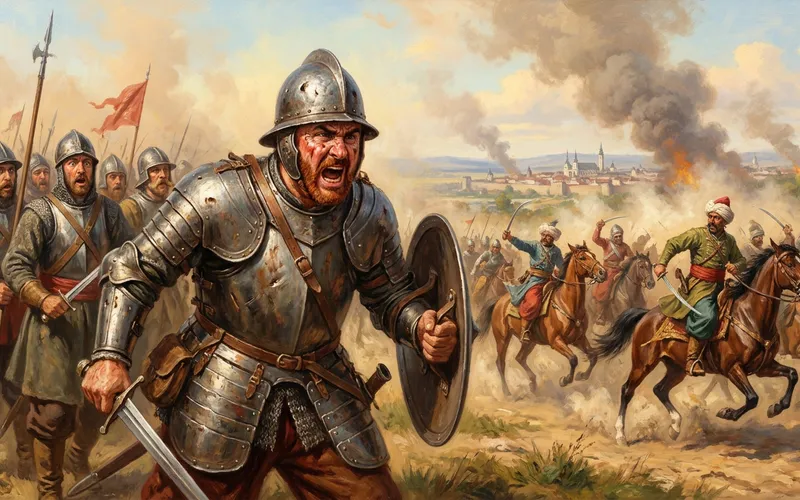
When Kara Mustafa’s light cavalry advanced on the line, Smiljko suddenly found himself out in front of everyone.
No one is quite sure how it happened. Jan later claimed that Smiljko had simply started walking forward in the middle of the speech, and that no one stopped him because everyone assumed he had a reason. Keglević wrote in his report that “the soldier Barkić displayed exceptional initiative.” Smiljko himself said only: “I’d been waiting three weeks to sit down. Then I decided it would be faster to just finish it.”
He shouted at the Turks. Not in Turkish — he shouted at the Turks, in Bosnian, which the Turks may well have understood, since Bosnian at the time was geographically close enough to get the point across.
He shouted, roughly: “LET ME FINISH THIS SO I CAN SIT DOWN, DAMN YOU ALL!”
The Ottoman light cavalry, accustomed to organised resistance, was not psychologically prepared for one exhausted Bosnian charging at them with the expression of a man who had more important business to attend to.
They swerved left.
That opened a gap which Captain Keglević, a soldier to his core, instinctively exploited. A hundred and twenty Croats surged forward behind Smiljko. Within twenty minutes, that section of the line had been broken.
Jan Podlaski, running in the second wave, saw Smiljko fighting and thought: this man is either mad or a saint, and a saint probably doesn’t swear like that.
Around noon, King Sobieski’s Winged Hussars launched their great charge from the heights of Kahlenberg — some three thousand winged cavalry, the largest cavalry charge in European history, thundering down the slope onto the Ottoman camp like a living wind. Seeing it, Kara Mustafa at first thought he was seeing angels, or demons from hell. It was both, depending on which side you stood on.
By evening, the Ottomans were fleeing. Vienna was free.
V. The Night After the Battle
Smiljko sat down on a stone by some ruined wall and closed his eyes.
Jan sat down beside him.
For a long while, they said nothing.
“You’re alive,” Jan said, in his Bosnian-Polish-Latin Esperanto.
“Yes,” said Smiljko.
“You were first.”
“I didn’t plan to be.”
“I know. I saw your face. You looked like a man going to collect a debt, not lead a charge.”
Smiljko opened one eye.
“I just wanted to sit down,” he said.
Jan laughed. He laughed for a long time, the kind of laughter that comes after surviving something you weren’t sure you’d survive — a little hysterical, a little relieved, a little mad.
Smiljko watched him.
“What’s so funny?”
“You,” Jan said. “You liberated Vienna because you couldn’t sit down.”
Smiljko thought about that.
“Maybe,” he said. “But I’m sitting down now.”
And he sat. And he fell asleep within five minutes, on the stone, with his helmet still on his head and his sabre still in his hand, while Vienna smouldered here and there and the victorious soldiers sang and celebrated around him.
Captain Keglević looked at him and said only: “He’s earned it.”
VI. The Road to Biała Podlaska
The next morning, Jan told him:
“Come to Podlaska. You’ll have a bed. A real bed.”
Smiljko opened his eyes.
“Are you serious?”
“Serious. My family has a house. We have a room. You’ll have a bed, supper, and—” Jan paused, with that particular pause of a man about to reveal something important — “I have a sister.”
“A sister.”
“Małgorzata. Twenty-six years old. About this tall. Dark hair. Cooks well. Swears better.”
Smiljko sat up.
“Why are you telling me about your sister?”
Jan looked him straight in the eye.
“Because a man who yesterday charged ahead of a hundred and twenty soldiers at Ottoman cavalry because he was too nervous to sit down — that man is exactly right for Małgorzata. She’s quite nervous too.”
Smiljko considered this.
“Fine,” he said. “But we rest along the way.”
They did not rest.
Jan was an enthusiastic traveller, prone to singing, prone to conversations with peasants they met along the road, prone to detours which, according to him, were “shorter but more scenic,” and according to Smiljko were “longer and pointless.”
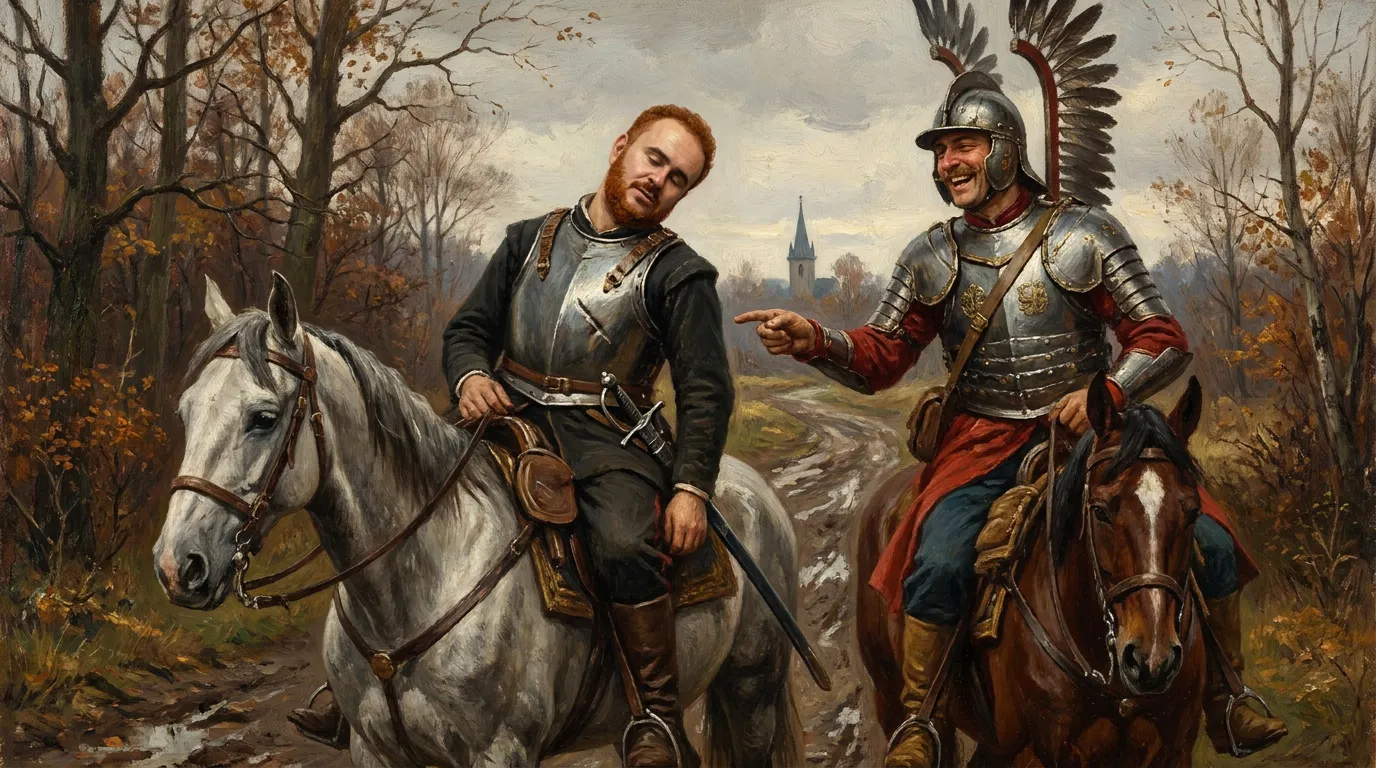
Smiljko slept on his horse.
This is not a figure of speech. Smiljko Barkić, who from Oćevija to Vienna had demanded, for three weeks, a rest no one gave him, who from accumulated nervous energy had charged into Ottoman cavalry like a cannonball with legs — that same Smiljko, from Vienna to Biała Podlaska, rested quite literally. His head lolled to the left, his hands held the reins loosely, and the horse — old, wise, grey, named Pepeljko, which Smiljko considered an insult — walked alongside Jan’s horse as if the entire situation were, to him personally, no problem whatsoever.
Jan once woke him because they’d come upon a beautiful view of the Vistula.
“Smiljko, look—”
“Mm,” said Smiljko, and went back to sleep.
Jan explained the situation to a passing peasant: “My friend liberated Vienna, and now he’s sleeping. Perfectly normal.”
The peasant nodded as though this were entirely reasonable.
VII. Biała Podlaska
They arrived in Biała Podlaska in October, when the lime trees had already lost their leaves and the air carried that sharp scent winter sends ahead like a scout.
The Podlaski family home was large, wooden, warm. The father — a broad man with a moustache even bigger than Jan’s — met them at the threshold, embraced Jan, and shook Smiljko’s hand with the kind of grip that reveals character.
And then Małgorzata came out of the house.
Smiljko was tired. Smiljko was filthy from the road. Smiljko had spent years on military campaigns and had no illusions about romance.
But Małgorzata was — Jan had been right — tall and dark-haired, and she looked at Smiljko with a mixture of curiosity and scepticism that said, at once: this is not a woman you can grumble at without getting an answer.
“You’re the Bosnian?” she said, in Latin.
“Yes,” said Smiljko.
“Jan says you liberated Vienna.”
“Jan exaggerates.”
“Jan says you charged the Turks because you couldn’t sit down.”
Smiljko paused.
“That is… partly true.”
Małgorzata looked at him a moment longer.
“Come in,” she said. “Supper’s ready.”
That was the beginning.
Smiljko Barkić of Oćevija married Małgorzata Podlaska the following spring. Jan was his best man, which Smiljko accepted on the condition that “I need someone who won’t sing during the ceremony” — a condition Jan neither promised nor kept.
Captain Keglević, in his final report on the battle of Vienna, listed Smiljko Barkić as a soldier who had “displayed unconventional but effective combat initiative.” It was the most tactful description Keglević could come up with.
Smiljko lived in Biała Podlaska for the rest of his life. He learned enough Polish to hold a conversation, but never quite enough to stop sounding like something was bothering him. Małgorzata learned a few Bosnian words, mostly the ones Smiljko used when he was nervous, which turned out to be useful, since she understood him immediately.
They had four children. They named the first son Jan.
Jan Podlaski was his godfather, and told everyone it had been his idea.
Smiljko did not contradict him.
Sometimes friendship matters more than accuracy.